

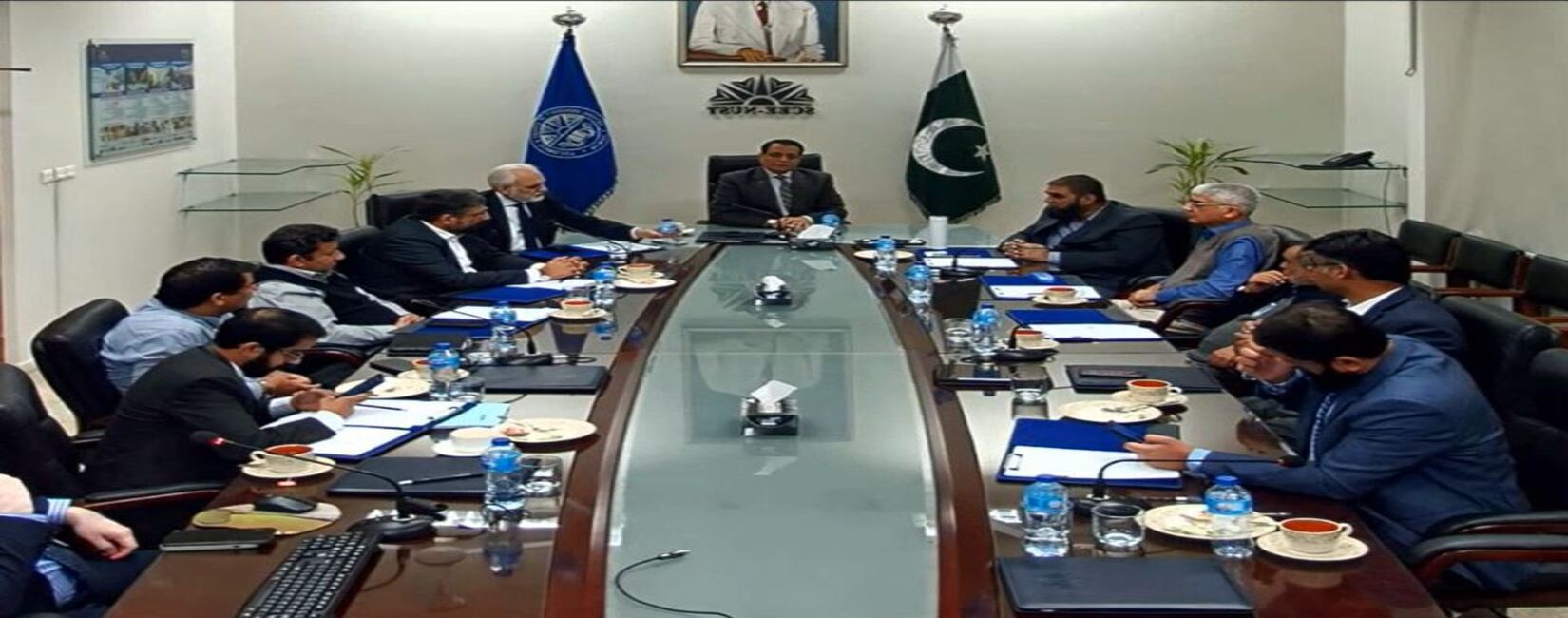
13th Industrial Advisory Board (IAB) meeting of SCEE (NICE)
-The 13th Industrial Advisory Board (IAB) meeting of SCEE (NICE) was held on 18th November 2025 at NUST under the chairmanship of Prof. Dr. Muhammad Irfan, Principal & Dean SCEE. The meeting was attended by eminent industry and academic experts, including Dr. Shahbaz Khan (UNESCO Chair and International Expert, Online), Engr. Munawar Iqbal (Director General Hydropower, Private Power & Infrastructure Board), Dr. Muhammad Rizwan (Principal Engineer, NESPAK), Dr. Asim Inam (GM Construction, NHA, Online), and Mr. Abdul Samad (President Alumni SCEE), along with senior faculty members of SCEE.
The participants appreciated SCEE’s continued academic progress, curriculum improvements, and its strong national and regional standing, highlighting NUST’s ranking as #3 in South Asia and sustained excellence within Pakistan. The Board was briefed on curriculum enhancements made in response to the previous IAB recommendations, including the integration of AI in the Built Environment, expanded software-based learning, restructuring of core civil engineering courses, and the introduction of new compulsory courses to strengthen applied knowledge.
Industry members expressed satisfaction with the inclusion of advanced design and analysis software such as ETABS, TEKLA Structures, and STAAD Pro, recognizing their relevance to professional practice. Emphasis was placed on strengthening practical demonstrations, enhanced lab-theory alignment in structural courses, and introducing visual and physical learning components to improve student understanding of complex engineering concepts.
Dr. Shahbaz Khan commended SCEE for its structured progress and recommended further integration of AI, modeling, and groundwater-related software into teaching and research. Discussions were also held on declining postgraduate enrollments, where suggestions such as micro-credentials, graduate certificates, leadership training, and international collaborations were deliberated. The Chair clarified ongoing initiatives, including industry co-supervision of research, student exchange programs, and international research internships, while ensuring alignment with regulatory frameworks.
The meeting concluded with a reaffirmed commitment to strengthen academia–industry collaboration, enhance applied and industry-relevant education, and continuously align curriculum, research, and professional skills with evolving national and global engineering demands.